
INTRODUCTION
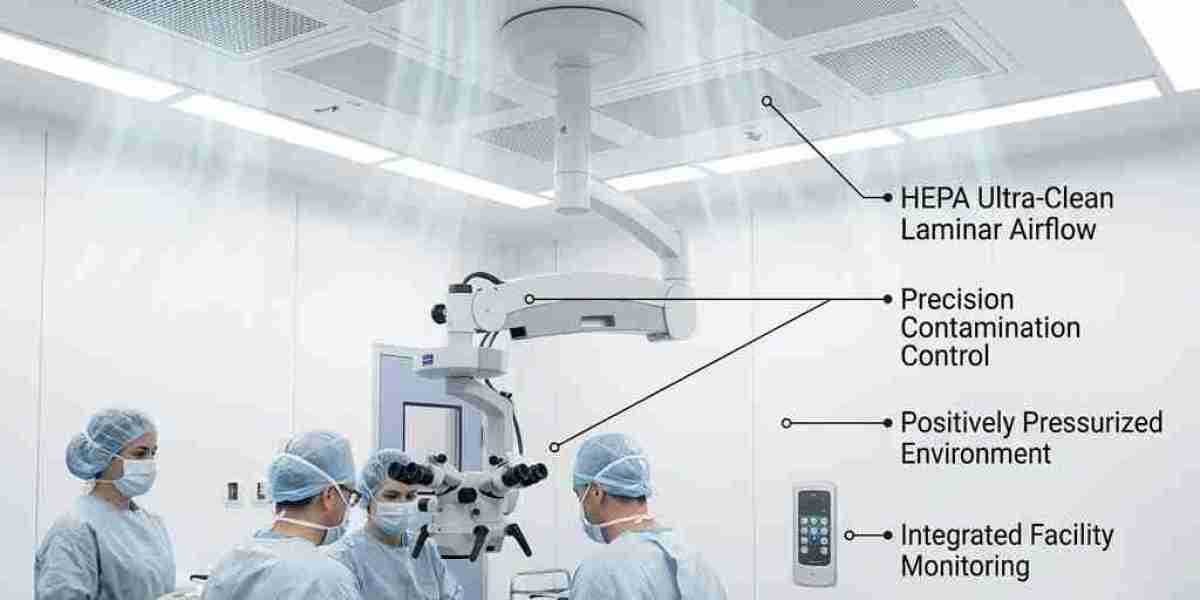
Hiring a Modular Ophthalmic OT Setup Company in India is an important investment for hospitals, eye-care centres, and specialty clinics planning modern cataract, glaucoma, retinal, corneal, and other ophthalmic procedures. The total cost depends on the OT size, modular panel specifications, HVAC capacity, HEPA filtration, laminar airflow requirements, electrical infrastructure, medical gases, surgical lighting, equipment integration, testing, validation, and whether the project is a new construction or a retrofit. Current Indian market references show broad modular OT pricing, with ophthalmic OT infrastructure commonly falling within a lower range than highly specialized cardiac, neuro, or hybrid theatres; therefore, hospitals should compare detailed scopes rather than relying on a single per-square-foot figure.
What Is the Average Cost of a Modular Ophthalmic OT in India?
There is no single fixed average price for a modular ophthalmic operation theatre.
As an initial budgeting guide, a basic modular ophthalmic OT may start around ₹25 lakh–₹35 lakh, while a more comprehensive turnkey ophthalmic OT with advanced HVAC, HEPA filtration, laminar airflow, electrical systems, medical gases, specialized finishes, testing, and commissioning can commonly reach approximately ₹35 lakh–₹60 lakh or more.
A recent Indian market reference places modular OT infrastructure with HVAC, laminar flow, flooring, and lighting at approximately ₹25–₹50 lakh for an ophthalmic OT, while broader modular OT market estimates extend from roughly ₹30 lakh to ₹1.5 crore depending on specification and integration.
These figures should be treated as indicative planning ranges, not quotations. The final cost can change substantially based on project specifications, location, site conditions, equipment brands, taxes, civil work, and the scope included in the vendor's quotation.
Why Does the Cost Vary So Much?
An ophthalmic OT is not simply a room with modular panels.
A complete project can involve:
- Modular wall and ceiling systems
- HVAC
- HEPA filtration
- Laminar airflow
- Temperature and humidity control
- Positive pressure management
- Medical gas systems
- Electrical infrastructure
- Medical-grade flooring
- Surgical lighting
- OT control panels
- Hermetically sealed doors
- Equipment integration
- Environmental monitoring
- Testing and commissioning
Each component can significantly influence the final project price.
Indicative Cost Categories
| Project Type | Indicative Planning Range |
|---|---|
| Basic modular ophthalmic OT | ₹25–35 lakh |
| Standard turnkey ophthalmic OT | ₹35–50 lakh |
| Advanced OT with enhanced airflow and filtration | ₹45–60 lakh+ |
| Premium/specialized OT with extensive equipment integration | ₹60 lakh+ |
These ranges are intended for preliminary budgeting only. Market references show that modular OT pricing varies significantly according to scope and specifications.
1. Modular Wall and Ceiling Panels
The modular envelope forms an important part of the OT infrastructure.
Common specifications can include:
- PPGI panels
- Powder-coated panels
- HPL surfaces
- Stainless-steel panels
- Insulated sandwich panels
- Flush-mounted wall systems
- Sealed ceiling systems
The choice of material affects:
- Initial cost
- Durability
- Cleaning requirements
- Chemical resistance
- Appearance
- Maintenance
- Expected service life
Stainless steel generally carries a higher material cost than coated panel systems.
Therefore, hospitals should specify the panel material, thickness, insulation core, surface finish, and installation method clearly before comparing quotations.
2. HVAC System Cost
HVAC is one of the most important cost components.
An ophthalmic OT requires controlled environmental conditions rather than ordinary comfort air-conditioning.
The HVAC design may address:
- Temperature
- Humidity
- Fresh air
- Air changes
- Filtration
- Pressure
- Air distribution
- Return-air configuration
The final HVAC cost depends on:
- Room volume
- Cooling load
- Airflow requirement
- AHU capacity
- Filtration stages
- Ductwork
- Control systems
- Existing building infrastructure
A new greenfield project may have different HVAC costs from a retrofit project.
3. HEPA Filtration
HEPA filtration is frequently incorporated into controlled OT environments.
Costs can vary according to:
- Filter efficiency
- Number of filters
- Filter dimensions
- Housing type
- Terminal modules
- Sealing arrangement
- Testing requirements
The quotation should clearly identify the filtration specification rather than simply stating "HEPA filter."
4. Laminar Airflow System
Laminar or unidirectional airflow systems can add to the overall project cost.
The system may include:
- Airflow ceiling
- Plenum
- HEPA filter modules
- Diffusers
- Air distribution components
- Control systems
- Supporting AHU capacity
The size of the controlled airflow zone and required airflow performance influence the cost.
Hospitals should therefore ask vendors to specify the airflow area, filtration arrangement, design airflow, and testing scope.
5. Electrical Infrastructure
A modern ophthalmic OT requires reliable electrical infrastructure.
Depending on the design, the project may include:
- OT distribution board
- Medical isolation system
- Insulation monitoring
- Emergency power
- UPS connections
- Equipotential bonding
- Dedicated equipment outlets
- Lighting circuits
- Control-panel wiring
The final electrical cost depends on the number and type of equipment being installed.
6. Medical Gas Systems
Medical gas requirements depend on the clinical procedures and hospital infrastructure.
Potential services include:
- Oxygen
- Medical air
- Vacuum
- AGSS where required
The cost depends on whether the project involves only terminal installation or also includes new pipeline infrastructure and connection to the hospital's central medical-gas system.
7. Surgical Lighting
Ophthalmic procedures require appropriate surgical illumination.
The budget may include:
- LED surgical lights
- Ceiling-mounted lights
- Adjustable lighting
- Examination lighting
- Procedure-specific illumination
Different manufacturers and performance specifications can create substantial price differences.
Therefore, hospitals should compare lighting specifications rather than simply comparing the brand or headline price.
8. Ophthalmic Equipment Integration
The modular OT infrastructure may need to accommodate equipment such as:
- Operating microscope
- Phacoemulsification system
- Vitrectomy equipment
- Surgical laser systems
- Patient monitors
- Ophthalmic surgical tables
- Surgical displays
The clinical equipment itself may be purchased separately from the OT infrastructure.
This distinction is important because a quotation for a modular OT may not include all ophthalmic surgical equipment.
Hospitals should request a detailed inclusion and exclusion list.
9. Flooring
OT flooring must support hygiene, cleaning, durability, and safe movement.
Possible options include:
- Medical-grade vinyl
- Conductive flooring
- Seamless flooring
- Epoxy flooring
Cost depends on:
- Material
- Thickness
- Area
- Installation
- Coved skirting
- Subfloor preparation
Existing floors may require additional preparation before installation.
10. Hermetically Sealed Doors
Controlled operation theatres commonly require appropriately sealed doors.
Options may include:
- Manual sliding doors
- Automatic sliding doors
- Hinged doors
- Hermetically sealed doors
Features such as automatic operation, interlocks, vision panels, touchless controls, and specialized sealing can increase the price.
11. OT Control Panel
An integrated control panel can provide centralized access to selected OT functions.
Depending on the specification, it may control or display:
- Temperature
- Humidity
- Pressure
- Lighting
- System status
- Alarms
- Timers
Advanced control systems cost more than basic electrical control panels.
12. Environmental Monitoring
Environmental monitoring can add value to the OT by allowing staff to observe important conditions.
Monitoring may include:
- Temperature
- Relative humidity
- Differential pressure
- Filter status
- Airflow-related parameters
The cost depends on the number of sensors, displays, controllers, data logging, and alarm functions.
13. Testing and Commissioning
Testing should be included in the project budget.
Depending on the project specifications, commissioning may include:
- Airflow measurement
- Air velocity measurement
- HEPA filter integrity testing
- Pressure differential testing
- Temperature testing
- Humidity verification
- Particle testing
- Electrical testing
- Medical gas testing
A lower quotation that excludes testing may not actually be cheaper once commissioning is added.
14. Validation and Documentation
Hospitals should ask whether validation documentation is included.
Possible documentation includes:
- Approved drawings
- Equipment specifications
- Test reports
- Air-balancing reports
- Filter certificates
- Commissioning reports
- Operation manuals
- Maintenance documentation
Complete documentation can simplify future maintenance and performance verification.
Greenfield vs Retrofit Cost
One of the biggest cost differences comes from the type of site.
Greenfield Project
A new facility can be easier to coordinate because:
- HVAC routes can be planned early
- Electrical infrastructure can be designed around the OT
- Ceiling heights can be optimized
- Medical gases can be planned in advance
- Structural requirements can be incorporated during construction
Retrofit Project
An existing hospital may involve:
- Demolition
- Existing ductwork
- Structural restrictions
- Limited ceiling height
- Existing electrical limitations
- Existing medical-gas routes
- Restricted working hours
- Hospital infection-control requirements
Consequently, retrofit costs can be significantly higher than a comparable greenfield installation.
Does Location Affect the Cost?
Yes.
Project location can influence:
- Transportation
- Labour
- Accommodation
- Material availability
- Local subcontractor costs
- Site accessibility
- Project duration
A project in a major metropolitan area may have different labour and logistics costs from a project in a smaller city.
Hospitals should therefore request a site-specific quotation.
How Does OT Size Affect the Price?
Larger rooms generally require more:
- Panels
- Flooring
- Ceiling area
- Ductwork
- Airflow capacity
- Lighting
- Electrical points
However, the cost does not always increase proportionally with room area because certain components are fixed-cost items.
For example, one control system or one basic AHU does not necessarily double in price when room area doubles.
This is why comparing vendors purely by price per square foot can be misleading. A recent Indian cost analysis similarly notes that modular OT costs do not scale linearly with area because many systems have fixed components.
What Is Usually Excluded From a Modular OT Quote?
Hospitals should carefully check exclusions.
A basic OT infrastructure quotation may not include:
- Ophthalmic microscope
- Phaco machine
- Vitrectomy machine
- Patient monitor
- Operating table
- Anaesthesia equipment
- C-arm
- Major civil construction
- Chiller plant
- DG upgrade
- Hospital-wide medical gas pipeline
- Fire-system modifications
- Statutory fees
- GST
- Annual maintenance contract
The scope should be clearly documented before placing an order.
How Can Hospitals Control the Project Budget?
Define the Scope
Prepare a detailed requirement document covering:
- Room dimensions
- Panel specifications
- HVAC requirements
- Filtration
- Laminar airflow
- Electrical systems
- Medical gases
- Lighting
- Monitoring
- Testing
Compare Like-for-Like Quotations
Do not compare one vendor's turnkey quotation with another vendor's shell-only quotation.
Separate Clinical Equipment
Create separate budgets for:
- OT infrastructure
- HVAC
- Medical gases
- Electrical systems
- Ophthalmic equipment
This makes capital planning clearer.
Consider Lifecycle Cost
A cheaper initial system may have higher:
- Energy costs
- Filter replacement costs
- Maintenance costs
- Downtime
- Repair requirements
The better choice is usually the system offering an appropriate balance between capital cost and long-term performance.
What Should Hospitals Ask a Setup Company Before Hiring?
Hospitals can ask:
- What exactly is included in the quotation?
- Is HVAC included?
- Is HEPA filtration included?
- Is laminar airflow included?
- What panel material is specified?
- Are electrical systems included?
- Are medical gas terminals included?
- Is testing included?
- Is validation included?
- Is commissioning included?
- Are drawings and documentation included?
- What is excluded?
- What warranty is provided?
- Is an AMC available?
- How will the system be maintained?
These questions make vendor comparison more transparent.
Why Is Choosing the Right Setup Partner Important?
The lowest quotation is not necessarily the best choice for a specialized ophthalmic OT.
A capable provider should understand the relationship between:
- OT architecture
- HVAC
- Airflow
- Filtration
- Electrical infrastructure
- Medical gases
- Equipment
- Workflow
- Testing
- Maintenance
Integrated planning can help reduce coordination problems and avoid costly modifications later.
Conclusion
The average cost of hiring a Modular Ophthalmic OT Setup Company in India can vary considerably depending on the size, specification, HVAC design, HEPA filtration, laminar airflow system, modular materials, electrical infrastructure, medical gases, equipment integration, testing, commissioning, and site conditions. For preliminary planning, hospitals can consider approximately ₹25 lakh–₹60 lakh or more for an ophthalmic modular OT, while recognizing that the final project value must be established through a detailed site survey and scope-based quotation. Current Indian market references demonstrate similarly broad modular OT cost ranges and show why specifications and scope are more useful than a single headline price. For customized ophthalmic OT planning, modular construction, HVAC, airflow management, filtration, installation, testing, and commissioning, Altus Airflow can support hospitals in developing controlled and application-specific operation theatre infrastructure.
Frequently Asked Questions
1. What is the average cost of a Modular Ophthalmic OT Setup Company in India?
The cost of a project handled by a Modular Ophthalmic OT Setup Company can broadly range from around ₹25 lakh to ₹60 lakh or more, depending on specifications, HVAC, filtration, laminar airflow, equipment integration, and site conditions.
2. Does the cost include ophthalmic surgical equipment?
Usually, the infrastructure quotation from a Modular Ophthalmic OT Setup Company may not include major clinical equipment such as operating microscopes, phacoemulsification systems, or vitrectomy machines. Hospitals should confirm all inclusions and exclusions.
3. Does HVAC significantly affect ophthalmic OT cost?
Yes. A Modular Ophthalmic OT Setup Company may need to design specialized HVAC capacity for temperature, humidity, filtration, air changes, pressure, and controlled airflow, all of which influence the project cost.
4. Is laminar airflow included in the quoted cost?
It depends on the project specification. Hospitals should confirm whether the Modular Ophthalmic OT Setup Company has included the laminar airflow ceiling, HEPA filters, plenum, supporting AHU capacity, controls, and testing.
5. Does an existing hospital cost more to upgrade?
A retrofit can cost more because a Modular Ophthalmic OT Setup Company may need to work around existing structures, HVAC systems, electrical services, medical gases, ceiling heights, and operational hospital areas.
Read Our Previous Blog------>How is a Laminar Airflow System Turnkey Project Company different from a general HVAC contractor?