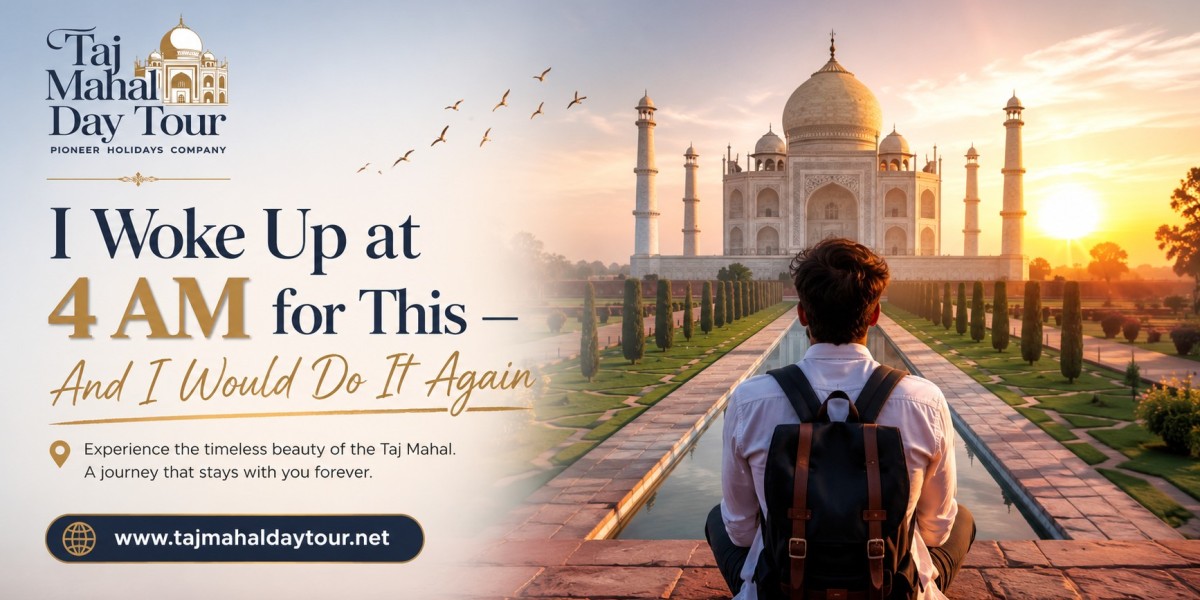

There are some mornings you simply cannot forget. The kind where the cold air bites your face, the city around you is still asleep, and you are standing in front of something so massive, so quiet, so impossibly white that your brain refuses to process it as real.
That was my morning at the Taj Mahal.
I had been planning this taj mahal tour for weeks. Not because I hadn't heard of the place — every Indian has grown up seeing it in textbooks, on currency notes, on the walls of tourist offices — but because I had always pushed it to the back of my mind with the usual excuse: "It's too crowded," or "I'll go someday." It took a friend cancelling our Rajasthan trip for me to finally say fine, let's go to Agra.
And honestly? Best accidental decision of my life.
Getting There Is Easier Than You Think
Most people assume Agra is far. From Delhi, it is barely 200 kilometres. The Gatimaan Express takes you there in about 100 minutes and drops you right in the heart of the city. You could wake up in Delhi, be standing in front of the Taj by 7 AM, and be back home for dinner.
That's exactly what a lot of travellers who book through tajmahaldaytour.net do — a full day trip from Delhi without needing to book a hotel, manage luggage, or worry about anything.
If you are driving, the Yamuna Expressway is clean, well-marked, and genuinely pleasant early in the morning when traffic is thin.
The First Sight: Nothing Prepares You
I don't care how many photos you have seen. When you walk through the Great Gate — the Darwaza-i-Rauza — and the Taj Mahal appears framed perfectly within that archway, something genuinely shifts inside you.
It's not just that it's beautiful. It's that it's more beautiful than you expected, and you expected a lot.
The marble looks different depending on the light. At sunrise, it turns a pale peachy gold. As the morning progresses, it moves through pink, then white, then a cooler blue-grey in shade. I sat on one of the garden benches for a full twenty minutes doing absolutely nothing except watching it change. The friend I had come with thought I was being strange. I think I was being sane for the first time in a while.
What Most Tourists Skip (But Shouldn't)
Here is the thing nobody tells you before your taj mahal tour: the Taj Mahal is not one building. It's a complex, and the parts people rush past are sometimes the most interesting.
The Mosque on the left — a red sandstone building that actually faces Mecca. Many tourists walk right by it.
The Jawab on the right — built purely for symmetry, since a second mosque facing the wrong direction would be religiously incorrect. It's a fascinating piece of architectural honesty. The Mughals cared so much about balance that they built an entire mirror structure just so the composition looked right.
The base platform (plinth) — walk around it. The inlay work up close is almost incomprehensible. Tiny pieces of semi-precious stone — lapis lazuli, carnelian, jade, malachite — fitted together into floral patterns with no visible gaps. The craftsmen who built this in the 1630s had no power tools, no digital precision, nothing. Just hands and time.
The reflecting pool — everyone photographs it, but few actually sit beside it and wait. When the wind dies down, you get a reflection so perfect it looks like the Taj is floating.
The mausoleum interior — cenotaphs of Shah Jahan and Mumtaz Mahal are here, surrounded by a delicate marble screen. The real tombs are in a chamber below, at ground level. Photography is not allowed inside, which I think is actually a good thing. It forces you to actually look.
A Few Things I Wish I'd Known
Let me save you the learning curve.
Wear shoes you can slip off easily. You will remove them when entering the mausoleum. Shoe covers are provided at the gate, but removing proper boots in a queue while people press against you from all sides is not enjoyable.
Carry cash for a water bottle. There are vendors inside, but card payments are not universal.
The garden path gets hot. By 10 AM, the marble reflects heat aggressively. Light-coloured, loose clothing is not a suggestion — it's practically survival advice in summer.
Friday is partial closure. The Taj Mahal remains closed to non-Muslim visitors on Friday mornings for prayers. If your travel day falls on a Friday, plan to arrive after 12 PM.
Sunrise entry is worth the early alarm. The first entry slot opens before sunrise. You'll have maybe 30 to 40 minutes with far fewer crowds. This is when the photos you actually keep get taken.
The Human Story Underneath All the Architecture
Here is what I kept thinking about as I wandered around.
Shah Jahan built this for his wife, Mumtaz Mahal, who died in 1631 during the birth of their fourteenth child. Construction began the same year and wasn't completed until 1653. Twenty-two years. Over twenty thousand workers. Marble brought from Makrana in Rajasthan, gems from Persia, Turkey, and China.
And then, after all of that, Shah Jahan himself was imprisoned by his own son — Aurangzeb — in the Agra Fort across the river. He spent the last eight years of his life looking at the Taj Mahal from a window. When he died, he was buried next to Mumtaz in that same marble chamber.
That story doesn't make the Taj Mahal prettier. But it makes it heavier, somehow. More real. It stops being a postcard and becomes something you feel in your chest.
Agra Beyond the Taj
If your taj mahal tour ends at the gate, you are leaving a lot behind.
Agra Fort is 15 minutes away and deserves at least two hours. It was the primary residence of Mughal emperors before the capital shifted to Delhi. The architecture is completely different from the Taj — red sandstone, heavy, military, with glimpses of the marble palace Shah Jahan added inside. The octagonal tower where he was imprisoned still looks out toward the Taj.
Mehtab Bagh is a garden directly across the Yamuna River. It was part of the original Taj Mahal complex and offers the best sunset view — you see the Taj lit in gold from behind, with the river in the foreground. Almost no one goes here. It's quiet in a way the Taj itself rarely is.
Itmad-ud-Daulah is sometimes called the Baby Taj. It's the tomb of Mumtaz Mahal's grandfather, built in white marble with pietra dura inlay — actually constructed before the Taj Mahal. The workmanship is extraordinary, and because it's smaller and less famous, you can stand as close as you like and actually examine the stone work at eye level.
Fatehpur Sikri, about 37 kilometres from Agra, is a ghost city. The Mughal emperor Akbar built his capital here in 1571 and abandoned it 14 years later, possibly because the water supply ran out. The entire complex has been sitting empty for 400 years, and walking through it feels genuinely strange — massive buildings, beautiful courtyards, all silent.
Planning Your Trip: The Practical Bit
Best months: October to March. The weather is cool and the sky is usually clear enough for proper photographs. July and August bring monsoon, which creates beautiful fog but also aggressive heat and humidity.
Time needed: The Taj Mahal alone needs about two to three hours if you're going at a reasonable pace. With Agra Fort and Mehtab Bagh, a full day. With Fatehpur Sikri added, you're looking at a long day or an overnight.
Entry fees: Indian nationals and foreign nationals are priced differently. There's an additional fee for entering the mausoleum itself, which is worth paying.
Guided vs. self-guided: A licensed guide makes a real difference here. The history is layered, and having someone point out what you'd otherwise walk past turns a sightseeing trip into something you actually understand. Tajmahaldaytour.net arranges licensed guides who are accredited by the Archaeological Survey of India.
Photography: You can photograph everything in the gardens freely. The interior of the mausoleum is the one exception. Wide-angle lenses do well here — the scale is hard to capture otherwise.
Why People Come Back
Something odd happens to a lot of people after their first visit. They talk about it for days. They show everyone their photos. And then, usually, they start planning to go back.
I think it's because the Taj Mahal is one of the very few things in the world that doesn't disappoint. Most things we've been told are extraordinary turn out to be fine. This one turns out to be more than advertised.
There is a kind of peace in standing in front of something built with that much intention. Not the peace of emptiness, but the peace of something being genuinely complete.
FAQs About Planning a Taj Mahal Tour
What is the best time to visit the Taj Mahal? October through March offers the most comfortable weather. Sunrise slots — the first entry of the day — give you softer light, fewer crowds, and the famous colour shifts in the marble that photographers specifically chase.
How many hours should I spend at the Taj Mahal? Budget two to three hours if you want to explore the full complex thoughtfully — gardens, mosque, Jawab, plinth, and interior. If you're combining it with Agra Fort and Mehtab Bagh, plan for a full day.
Is the Taj Mahal open every day? It is open daily except Friday. On Fridays, it remains closed to non-Muslim visitors until early afternoon due to prayers at the mosque within the complex.
Can I visit the Taj Mahal from Delhi in a single day? Yes, absolutely. The Gatimaan Express gets you to Agra in roughly 100 minutes. Day tours from Delhi are very practical and popular. Tajmahaldaytour.net specialises in exactly this kind of organised same-day trip.
What should I not bring inside the Taj Mahal? Food, tripods, large bags, and selfie sticks are prohibited. Keep a small bag with essentials only. Lockers are available at the gate for larger items.
Is there a dress code for visiting? No formal dress code, but modest, comfortable clothing is advisable — especially in summer. You will be removing shoes before entering the mausoleum, so easy footwear matters.
What is the difference between the main Taj Mahal complex and Agra Fort? The Taj Mahal is a mausoleum — it was built as a monument to Mumtaz Mahal and is architecturally serene and symmetrical. Agra Fort is a working royal complex — residential palaces, audience halls, and military architecture all together. They complement each other well and are only 15 minutes apart.
Are guides available at the Taj Mahal? Yes. Licensed guides are available at the gate and can be arranged in advance through tour operators. A good guide will walk you through details — symbolism in the inlay work, the engineering of the reflecting pool, the acoustic properties of the dome — that completely change how you experience the site.
Is the Taj Mahal worth visiting if I've already seen photos of it? The short answer is yes, more so than almost any other monument. Photographs of the Taj Mahal capture its shape. They don't capture its scale, the quality of the light on marble at different hours, or the feeling of standing inside something built with that level of intention. It's one of the few places where the real thing is genuinely more moving than any image of it.