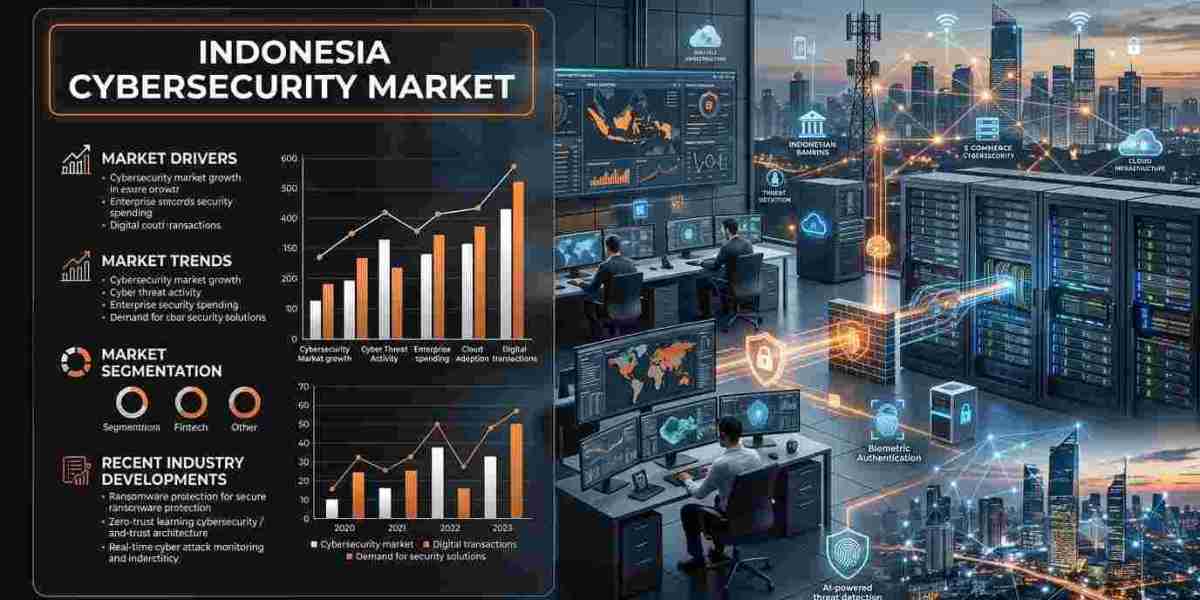

IMARC Group, a leading global market research and management consulting firm, has published its latest market intelligence report on the Indonesia Cybersecurity Market. The Indonesia cybersecurity market size increased from USD 1.4 Billion in 2025 to USD 1.6 Billion in 2026 and is projected to reach USD 6.7 Billion by 2034. Growth is being driven by the escalating frequency and sophistication of cyber threats, increased digitalization across industries, rising data privacy concerns, stringent regulatory requirements, the proliferation of Internet of Things (IoT) devices, rapid cloud adoption, and the increasing digitization of critical infrastructure.
Indonesia's cybersecurity market is being reshaped by a sharp escalation in threat volume alongside a maturing but still-developing regulatory framework. According to Indonesia's National Cyber and Crypto Agency (BSSN), the country recorded 5.5 billion cyberattacks in 2025, a steep increase over the 2020-2024 annual average, with 1.52 billion attacks already logged by mid-April 2026. These threats span personal data theft, online fraud, and system intrusions targeting government institutions, the economic sector, public services, and national security, pushing enterprises and government bodies across Java, Sumatra, Kalimantan, and Sulawesi to accelerate cybersecurity investment.
Indonesia Cybersecurity Market at a Glance
- Market Size (2025): USD 1.4 Billion
- Market Size (2026): USD 1.6 Billion
- Market Forecast (2034): USD 6.7 Billion
- Key Offering Categories: Network, Cloud, Application, and Endpoint Security; Firewall, Antivirus, Identity and Access Management, and Data Loss Prevention solutions
- Key End-User Verticals: BFSI, Healthcare, Manufacturing, Government and Defense, and IT and Telecommunication
How AI is Reshaping the Future of the Indonesia Cybersecurity Market
- AI-Powered Enterprise Security Platforms: TrendAI (formerly Trend Micro) went live with a local Indonesian data center in August 2026 hosting its unified AI-powered cybersecurity platform, TrendAI Vision One, giving Indonesian enterprises in-country data residency alongside AI-driven cloud, endpoint, network, and threat detection capabilities.
- AI-Enabled Mobile and Consumer Defense: ITSEC Asia partnered with smartphone maker Infinix in January 2026 to pre-install an AI-powered cyber defense app on new devices, targeting around 100,000 users in Indonesia as mobile threats continue to rise.
- AI as Both Shield and Threat Vector: Threat intelligence assessments from late 2025 into 2026 found AI-assisted phishing success rates reaching 54 to 60 percent in Indonesia, with deepfake-enabled incidents rising sharply year-over-year, underscoring why enterprises are simultaneously adopting AI-driven defenses while facing AI-powered attacks.
Grab a sample PDF of this report: https://www.imarcgroup.com/indonesia-cybersecurity-market/requestsample
Indonesia Cybersecurity Market Trends and Drivers
Demand is underpinned by the sheer scale and rising sophistication of cyberattacks facing Indonesian organizations. Threat intelligence assessments covering the period from December 2025 to May 2026 identified ransomware as the most disruptive threat category, with sustained double-extortion campaigns targeting government, materials, healthcare, and IT sector organizations, alongside industrialized mobile banking fraud and persistent botnet activity.
The market's structural differentiator is Indonesia's rapid digital transformation across finance, healthcare, e-commerce, and government services, which continues to widen the attack surface even as regulatory enforcement matures. A 2024 ransomware attack on Indonesia's Temporary National Data Center disrupted immigration services and the national student enrolment system for weeks, an incident BSSN has since cited as a key factor behind the sharp decline in Indonesia's National Cybersecurity Index score, which fell from 63.64 in 2023 to 47.50, dropping the country's global ranking from 48th to 84th out of 136 nations.
A third driver is tightening regulatory and compliance pressure. Nearly 68% of business and technology leaders in Indonesia now place cyber risk investment among their top three strategic priorities, according to PwC's 2026 Digital Trust Insights survey, with Indonesian organizations investing more in proactive cybersecurity strategies than Asia-Pacific and global peers as they adapt to the Personal Data Protection (PDP) Law's enforcement.
Government Schemes and Regulatory Initiatives Driving Demand
- Personal Data Protection (PDP) Law: Law No. 27 of 2022 establishes the core legal framework for personal data processing in Indonesia, applying both domestically and extraterritorially, and requires Electronic System Providers operating in or serving Indonesia to comply with defined data protection obligations.
- Draft Presidential Regulation on the PDP Agency: The government is progressing a draft regulation to establish a dedicated Personal Data Protection Agency (Badan Pelindungan Data Pribadi), which is expected to take over data protection oversight currently handled by the Ministry of Communication and Digital Affairs.
- BSSN Inter-Agency Cybersecurity Cooperation: Indonesia's National Cyber and Crypto Agency (BSSN) has entered memoranda of understanding with multiple government agencies to strengthen cybersecurity cooperation and improve the country's national cyber resilience posture.
- OJK Financial Sector Cybersecurity Requirements: Indonesia's Financial Services Authority (OJK) has introduced cybersecurity and data protection requirements for the financial sector, adding compliance pressure alongside the PDP Law for BFSI-sector organizations.
Indonesia Cybersecurity Market Industry Segmentation
The report has segmented the market into the following categories:
Breakup By Offering:
- Security Type: Network Security, Cloud Security, Application Security, Endpoint Security, Content Security, Others
- Solution Type: Firewall, Antivirus and Antimalware, Risk and Compliance Management, Identity and Access Management, Data Loss Prevention, Unified Threat Management, Intrusion Detection/Prevention System, Infrastructure Security, Encryption and Decryption, Others
Breakup By Deployment Mode:
- Cloud-based
- On-premises
Breakup By End User:
- BFSI
- Healthcare
- Manufacturing
- Government and Defense
- IT and Telecommunication
- Others
Breakup By Region:
- Java
- Sumatra
- Kalimantan
- Sulawesi
- Others
BFSI and Government and Defense remain among the most active end-user verticals, reflecting elevated ransomware and fraud targeting of financial institutions alongside sustained state-aligned threats against government systems.
Competitive Landscape
The Indonesia cybersecurity market features a mix of global platform vendors, telecom-backed security operations providers, and emerging domestic players. Notable participants include:
- TrendAI (formerly Trend Micro)
- Cisco (via Indosat Ooredoo Hutchison's Security Command Center)
- ITSEC Asia
- Zentara (Indonesian cybersecurity company founded in 2025)
- PT Abhinawa Sumberdaya Asia
Large global vendors continue to expand local infrastructure and data residency capabilities to meet PDP Law requirements, while domestic players such as Zentara are positioning themselves to compete with international platforms and expand Indonesia's own cybersecurity technology exports.
Market Concentration Analysis
- Java accounts for the bulk of Indonesia's cybersecurity demand, anchored by concentrated BFSI, government, and IT and telecommunication activity in Jakarta and other major business hubs.
- Ownership and capability are increasingly concentrated around global platform vendors building local data center infrastructure, such as TrendAI's August 2026 Indonesian data center launch, alongside telecom-backed security operations centers such as Indosat Ooredoo Hutchison's Cisco-powered Security Command Center.
- Smaller domestic players and startups such as Zentara and PT Abhinawa Sumberdaya Asia compete on niche services, local threat intelligence, and specialized consulting rather than head-on competition with large global platform vendors.
What Does The Full Report Cover?
- Historical, current, and forecast market size for the Indonesia cybersecurity market
- Market breakup by offering, deployment mode, end user, and region
- Regional analysis covering Java, Sumatra, Kalimantan, Sulawesi, and others
- Key growth drivers, restraints, and opportunities shaping the market
- Porter's Five Forces analysis and value chain assessment
- Competitive landscape, market structure, and player positioning
- Detailed profiles of major companies operating in the market
Recent News and Developments in the Indonesia Cybersecurity Market
- August 2026: TrendAI announced the go-live of a local Indonesian data center hosting its unified AI-powered cybersecurity platform, TrendAI Vision One, its 12th regional data center globally, aimed at giving Indonesian enterprises full in-country data residency.
- June 2026: Threat intelligence analysis covering December 2025 to May 2026 found ransomware remained the most disruptive threat category in Indonesia, with AI-assisted phishing success rates reaching 54 to 60 percent and deepfake incidents rising sharply year-over-year.
- January 2026: ITSEC Asia partnered with smartphone maker Infinix to pre-install an AI-powered cyber defense app on new devices, targeting approximately 100,000 users across Indonesia.
- January 2026: BSSN attributed Indonesia's declining National Cybersecurity Index score, down to 47.50 from 63.64 in 2023, to the 2024 ransomware attack on the Temporary National Data Center, with the country's global ranking falling to 84th from 48th out of 136 nations.
- December 2025: PwC's Digital Trust Insights 2026 survey found nearly 68% of Indonesian business and technology leaders ranked cyber risk investment among their top three strategic priorities, with 34% of organizations increasing investment in proactive cybersecurity strategies.
- September 2025: Indosat Ooredoo Hutchison partnered with Cisco to launch Indonesia's first Sovereign Security Operations Center, deploying Splunk Cloud Platform and Splunk Enterprise Security locally for the first time in the country.
Note: If you require specific details, data, or insights that are not currently included in the scope of this report, we are happy to accommodate your request. As part of our customization service, we will gather and provide the additional information you need, tailored to your specific requirements. Please let us know your exact needs, and we will ensure the report is updated accordingly to meet your expectations.
Key Questions This Report Answers
- How big is the Indonesia cybersecurity market and what is its growth outlook?
- What are the key growth drivers, restraints, and opportunities in the Indonesia cybersecurity market?
- Which offering, deployment mode, and end-user segments hold the largest share of the market?
- Which region leads the Indonesia cybersecurity market, and why?
- How are the PDP Law and other regulatory initiatives shaping cybersecurity demand?
- Who are the key players in the Indonesia cybersecurity market, and how is the competitive landscape evolving?
- What role is AI playing as both a cybersecurity defense tool and an emerging threat vector in Indonesia?
About Us
IMARC Group is a global management consulting firm that helps the world's most ambitious changemakers to create a lasting impact. The company provides a comprehensive suite of market entry and expansion services. IMARC offerings include thorough market assessment, feasibility studies, company incorporation assistance, factory setup support, regulatory approvals and licensing navigation, branding, marketing and sales strategies, competitive landscape and benchmarking analyses, pricing and cost research, and procurement research.
Media and Sales Contact
IMARC Group
Email: [email protected]
United States: +1-201-971-6302
India: +91-120-433-0800
United Kingdom: +44-753-714-6104