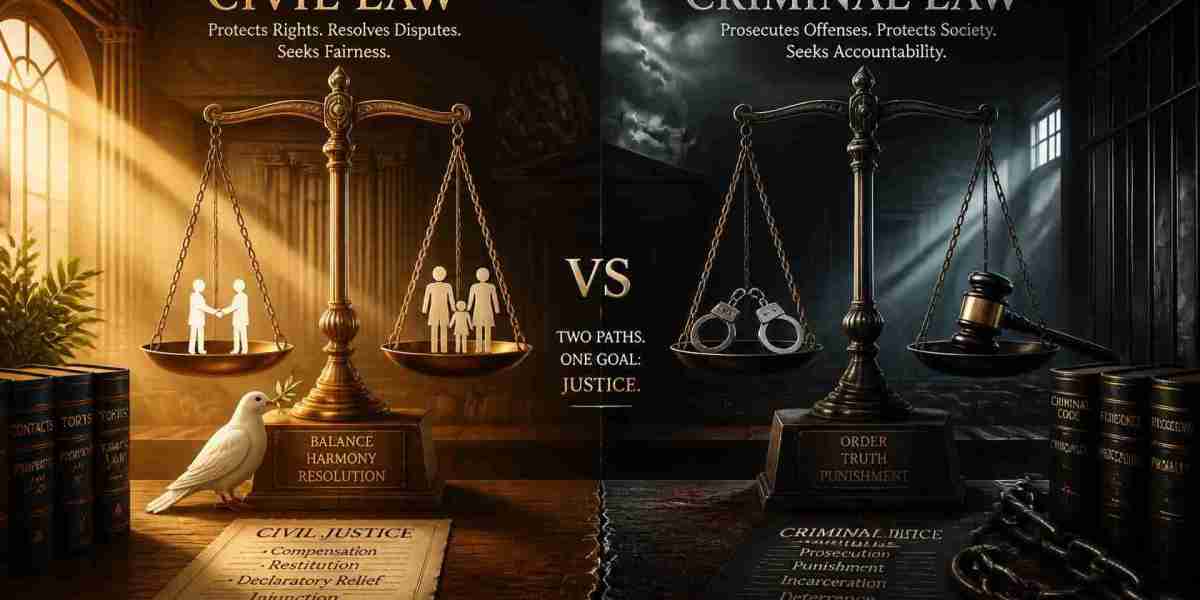

The legal system deals with many different kinds of disputes and unlawful behaviour. Two of its most important areas are civil law and criminal law. Although both involve legal rules, evidence, court proceedings, and decisions by judges or other decision-makers, their purposes and procedures can be quite different. Understanding Civil Law vs Criminal Law is therefore important for law students, professionals, and anyone who wants to understand how legal disputes are handled.
In England and Wales, civil proceedings generally concern disputes between people, businesses, or organisations, while criminal proceedings concern alleged offences. The differences extend to who brings the case, what must be proved, the courts involved, and what consequences may follow.
What Is Civil Law?
Civil law deals with disputes involving legal rights and responsibilities between parties. It covers a wide range of matters, including contractual disagreements, property disputes, debt, personal injury, negligence, and commercial claims.
The Courts and Tribunals Judiciary explains that civil justice covers disputes involving individuals, businesses, and organisations seeking to resolve disagreements or ensure their rights are respected. Many civil disputes are settled through complaints procedures, negotiation, or mediation without reaching a full trial.
For example, if a company fails to provide goods or services after receiving payment, the affected customer or business may have grounds for a civil claim. Similarly, a person who suffers a loss because of another party's alleged negligence may seek compensation.
Civil proceedings are generally focused on resolving the dispute and providing an appropriate remedy.
What Is Criminal Law?
Criminal law deals with behaviour that is defined as an offence. Theft, assault, fraud, robbery, and many other forms of unlawful conduct can fall within criminal law.
Criminal proceedings are brought against a defendant by a prosecutor. In England and Wales, the Crown Prosecution Service prosecutes many criminal cases. For less serious offences, charging decisions are often made by the police, while the CPS makes charging decisions in more serious cases.
Before bringing a prosecution, the CPS applies a two-stage test. The case must have enough evidence to provide a realistic prospect of conviction, and prosecution must be required in the public interest.
The purpose of a criminal prosecution is therefore different from that of a private civil claim.
Purpose of Civil Proceedings
One of the clearest ways to understand Civil Law vs Criminal Law is to consider the purpose of each process.
Civil proceedings are generally intended to resolve disputes and provide remedies for established legal rights or losses. A successful claimant may receive financial damages, although other forms of relief may also be available depending on the case.
For example, if a person proves that another party breached a contract and caused financial loss, the court may award damages according to the circumstances.
The Judiciary states that civil judges will normally make an award of financial damages to a successful party, with the amount depending on the circumstances of the claim.
Purpose of Criminal Proceedings
Criminal proceedings have a different objective. They determine whether a defendant has committed an offence and, where the defendant is convicted, what sentence should be imposed.
The consequences of a criminal conviction can include imprisonment, a fine, unpaid work, or other orders available under the applicable law. GOV.UK explains that criminal courts can impose different forms of sentence following conviction.
Therefore, while a civil case may focus on compensation or another remedy, a criminal case focuses on determining criminal responsibility and, where appropriate, sentencing.
Who Starts a Civil Case?
Civil proceedings are usually started by a claimant.
The claimant may be an individual, company, organisation, or another legal entity. The party responding to the claim is generally known as the defendant.
For example, a business may bring a claim against another company over an alleged breach of contract. An individual may also bring a claim following an alleged personal injury or property dispute.
Civil proceedings can involve more than two parties when the circumstances require it.
Who Starts a Criminal Case?
A criminal case is brought by the prosecution against a defendant.
This is an important difference because the victim of an alleged offence does not normally prosecute the defendant personally. A victim may provide evidence and participate as a witness, but the prosecution is conducted through the criminal justice system.
The CPS investigates neither crimes nor guilt itself; investigations are generally conducted by the police or another investigative body, while prosecutors assess evidence and make relevant prosecution decisions.
This structure helps distinguish a criminal prosecution from a private civil claim.
Different Standards of Proof
The standard of proof is another major difference.
In criminal proceedings, the prosecution has to prove the defendant's guilt. The court must be sure that the defendant is guilty before returning a guilty verdict. The CPS explains that this may also be described as being satisfied beyond reasonable doubt.
Civil proceedings generally use the balance of probabilities. In simple terms, the court considers whether a particular version of events is more likely than not.
Because the standards differ, a court considering a civil dispute and a criminal court considering related facts may reach different conclusions.
Evidence in Civil Cases
Evidence is central to civil proceedings. Depending on the nature of the dispute, evidence can include contracts, invoices, photographs, correspondence, witness statements, expert reports, records, and other relevant documents.
The parties generally present evidence supporting their respective positions. The court then considers the evidence and applies the relevant law to determine the issues in dispute.
The amount and type of evidence required will vary according to the particular claim.
Evidence in Criminal Cases
Evidence is equally important in criminal proceedings, but the prosecution carries the responsibility of proving the defendant's guilt.
Evidence can include witness testimony, CCTV footage, forensic material, digital information, documents, and expert evidence. The CPS explains that investigations may involve evidence such as victim and witness statements, CCTV, forensic evidence, and digital evidence.
The defence does not generally have to prove that the defendant is innocent. Instead, the prosecution must establish guilt to the required standard.
Courts for Civil Cases
Civil cases in England and Wales are mainly dealt with through the County Court. More substantial or complex cases may begin in the High Court.
Not every civil dispute reaches a trial. The Judiciary notes that many civil disputes are resolved outside court through negotiation, mediation, or established complaints procedures.
This means that reaching a legal settlement can be an important part of the civil justice process.
Courts for Criminal Cases
Criminal cases follow a different court structure.
Almost all criminal cases begin in a Magistrates' Court. Some are dealt with there completely, while serious cases may be sent to the Crown Court for trial.
The Criminal Procedure Rules explain that offences can be classified as summary, indictable only, or either way. The classification affects whether a case remains in the Magistrates' Court or proceeds to the Crown Court.
In a Crown Court trial, a judge normally sits with a jury. The jury decides whether the defendant is guilty based on the evidence presented at trial.
Possible Outcomes
Civil and criminal cases can produce very different outcomes.
A civil case may result in financial damages or another court order. The remedy depends on the legal issue, evidence, and circumstances of the claim.
A criminal case may result in a finding of guilt or not guilty. If the defendant is convicted, the judge or magistrates determine the appropriate sentence under the applicable legal framework.
The consequences of criminal proceedings can therefore differ substantially from those of civil litigation.
Can One Event Lead to Both?
Yes, the same incident can sometimes result in both civil and criminal proceedings.
For example, an alleged assault could lead to a criminal prosecution if the relevant offence is prosecuted. Separately, the injured person could potentially bring a civil claim concerning injuries or financial losses.
The two proceedings would still have different purposes and standards of proof. The criminal case would address whether an offence had been proved, while the civil claim would focus on the legal dispute and any appropriate remedy between the parties.
Why Understanding the Difference Matters
Understanding the distinction between civil and criminal law makes legal terminology easier to follow.
Words such as claimant, defendant, prosecution, conviction, damages, sentence, and acquittal have specific meanings within different parts of the legal process. Recognising the context in which these terms are used can help students understand legal cases more accurately.
It is also useful when reading court reports because two cases involving similar facts can involve completely different legal questions and outcomes.
Conclusion
Civil and criminal law are distinct areas of the legal system in England and Wales. Civil proceedings generally address disputes between parties and may result in remedies such as financial damages or other court orders. Criminal proceedings concern alleged offences and can result in conviction and sentencing when the prosecution proves guilt to the required standard.
The main differences involve their purpose, the parties involved, standards of proof, court structures, evidence, and possible outcomes. Understanding these distinctions provides a useful foundation for anyone studying law or seeking a clearer understanding of how legal proceedings work.







