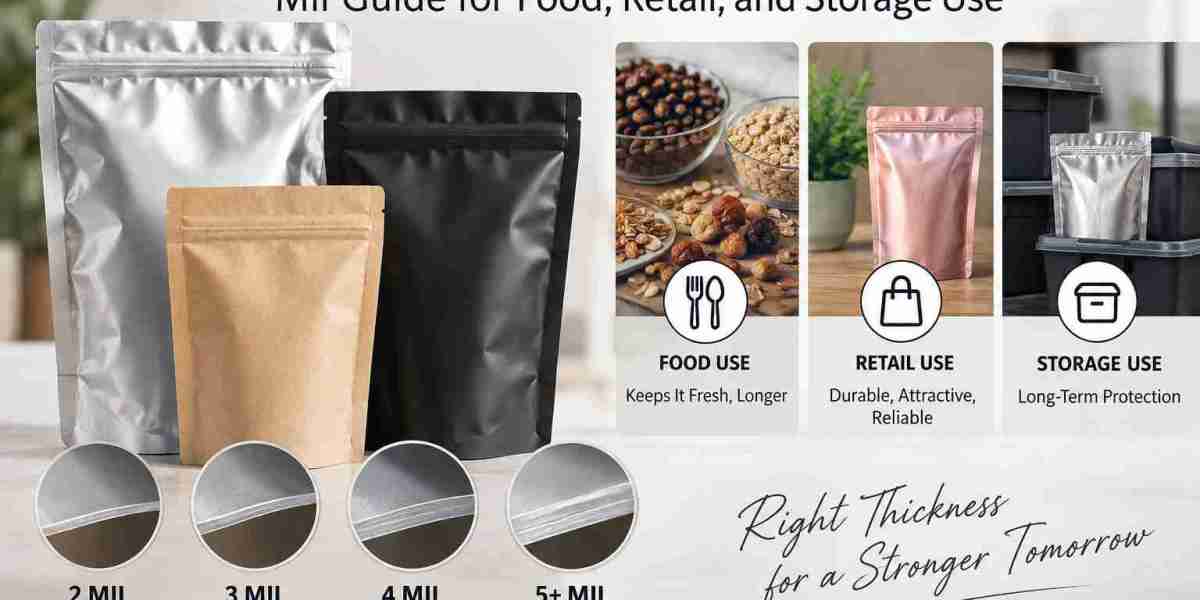

A number on a spec sheet rarely tells the whole story, and mylar bag thickness is a good example of that. Two bags can both list "5 mil" and still perform differently depending on what layers make up that thickness and what the bag is actually holding. Buyers comparing suppliers like premium mylar bags often run into this exact confusion, since thickness alone does not guarantee the right fit for every product. This guide breaks down what mil thickness actually measures, how it changes performance, and which range fits different use cases without guessing.
What "Mil" Actually Means
A mil is a unit of thickness equal to one-thousandth of an inch. It is not a brand name or a quality grade, just a physical measurement of how thick the material is from one side to the other.
A few reference points help put this in perspective:
- A standard grocery plastic bag measures well under 1 mil
- Regular printer paper is roughly 3–4 mils thick
- Most mylar bags for commercial use range between 3 mil and 7.5 mil
- The mil rating covers the entire laminate, not just one layer, since mylar is built from PET film, a metalized or foil layer, and a heat-sealable liner combined
Because that number represents a combined structure, two bags at the same mil rating can still differ in barrier strength depending on how those internal layers are proportioned.
Why Thickness Affects More Than Just Durability
It is easy to assume thickness only matters for physical toughness, but it influences several performance factors at once.
- Puncture resistance — thicker material withstands sharp edges, dense contents, and handling stress better
- Barrier performance — a thicker laminate generally slows oxygen and moisture transfer over long storage periods
- Seal strength — thicker films often hold a more consistent heat seal, especially on larger bag sizes
- Flexibility — thinner bags are easier to fill and seal quickly but sacrifice some structural rigidity
- Cost per unit — thickness and price scale together, so overbuying protection adds unnecessary expense
None of these factors work in isolation, which is why thickness selection should start with the product going inside the bag rather than an arbitrary preference for "thicker is always better."
Mil Thickness by Common Use Case
| Mil Thickness | Best Suited For | Typical Storage Duration |
|---|---|---|
| 3.0–3.5 mil | Single-serve sachets, lightweight snacks, short-term retail | Weeks to a few months |
| 4.0–4.5 mil | Flour, sugar, salt, dry mixes, standard retail food | 3–6 months |
| 5.0 mil | Coffee, grains, general food storage, most e-commerce shipping | 6–12 months, longer with absorbers |
| 5.5–7.0 mil | Bulk grains, legumes, emergency food supplies, export packaging | 1–25+ years |
| 7.5 mil and above | Dense or sharp-edged items, heavy-duty industrial and archival use | Long-term, specialty applications |
These ranges reflect general industry practice rather than a fixed rule, since product density, packing method, and storage environment all shift where a specific item lands on this scale.
Matching Thickness to Product Type
Products with sharp or irregular shapes need a thicker film regardless of how long they will be stored, since punctures are a physical risk independent of shelf-life goals. Powders and evenly distributed dry goods can often use a moderate thickness, while dense or oddly shaped items like beef jerky, granola, or hardware benefit from the added puncture resistance of 6–7 mil film.
Common Mistakes When Choosing Thickness
Several recurring mistakes lead to either overspending or premature packaging failure.
- Choosing based on price alone without checking the intended storage duration
- Using thin film for long-term storage, assuming an oxygen absorber alone will compensate
- Assuming all "5 mil" bags perform identically regardless of layer composition
- Ignoring product shape and sharp edges when selecting a thickness range
- Overbuying thickness for short-term retail products, which adds cost without meaningful benefit
Avoiding these mistakes usually comes down to matching thickness to the actual storage timeline and physical characteristics of the product, rather than defaulting to whatever thickness a previous order used.
For sharp-edged, dense, or long-duration storage needs specifically, buyers often skip the guesswork entirely and go straight to a pre-specified thick mylar bags option built for the 6–7.5 mil range, rather than trying to source a general-purpose bag and hoping it holds up under heavier contents.
How Thickness Interacts With Other Bag Features
Thickness does not operate independently from other specifications like size, closure type, or finish. A thicker bag paired with a weak seal still fails prematurely, and a well-sealed thin bag still tears under the weight of dense contents. For buyers comparing options across use cases, browsing a broader range like general mylar bags helps visualize how thickness pairs with size and closure choices across different product categories before finalizing a bulk order.
Why Testing Still Matters
Published mil ranges are a starting point, not a guarantee. Running a small pilot batch before committing to a full production order remains the most reliable way to confirm that a chosen thickness holds up under actual filling, sealing, and shipping conditions specific to one product.
Practical steps for testing before a bulk order:
- Fill and seal a small batch using the target thickness
- Run a drop test to check for puncture or seam failure
- Store a sample for several weeks under realistic conditions
- Check for seal integrity and any signs of moisture or oxygen ingress
- Compare results against the intended shelf-life target before scaling production
Cost Versus Protection: Finding the Right Balance
Thickness and price move together, which means every step up in mil rating adds cost per unit across a production run. That added cost only pays off if the product actually needs the extra protection.
A useful way to frame the decision:
- If the product is lightweight, uniform, and sold within a few months, a mid-range thickness usually covers the risk without overspending
- If the product has sharp edges, uneven weight distribution, or will sit in storage for years, the added cost of a heavier film prevents far more expensive losses from failed packaging
- If a business ships in bulk or across long distances, factoring in handling stress during transit often justifies a slightly higher thickness than the product alone would suggest
Businesses that skip this comparison tend to either overspend on thickness that adds no measurable benefit, or underspend and absorb losses later from punctured bags, failed seals, or spoiled inventory. Treating the decision as a cost-versus-risk calculation, rather than picking a number that "sounds durable," produces a more consistent result across repeat orders.
How Environmental Conditions Change Thickness Requirements
The same product can need a different thickness depending on where and how it will be stored. A bag sitting in a climate-controlled warehouse faces less stress than one destined for a garage, a shipping container, or a region with high humidity.
Conditions that typically call for a heavier film include:
- Frequent temperature swings between hot and cold
- High humidity environments where moisture ingress is a constant risk
- Long-distance shipping with multiple handling points
- Outdoor or semi-outdoor storage exposed to indirect sunlight
- Stacked pallet storage where lower bags bear consistent weight over time
Ignoring environmental exposure is one of the more common reasons a correctly chosen thickness still underperforms. The mil rating accounts for the product itself, but the surrounding conditions determine how much of that protection actually gets used up over the storage period.
Getting Thickness Selection Right the First Time
Thickness is one of the few packaging specifications that is difficult and costly to correct after a production run has already shipped. A bag that is too thin for its contents fails during storage or transit, while one that is unnecessarily thick adds cost without improving performance. Treating mil thickness as a decision tied directly to product type, storage duration, and physical handling conditions, rather than a single default number, is what separates packaging that performs reliably from packaging that only looks adequate on a spec sheet.