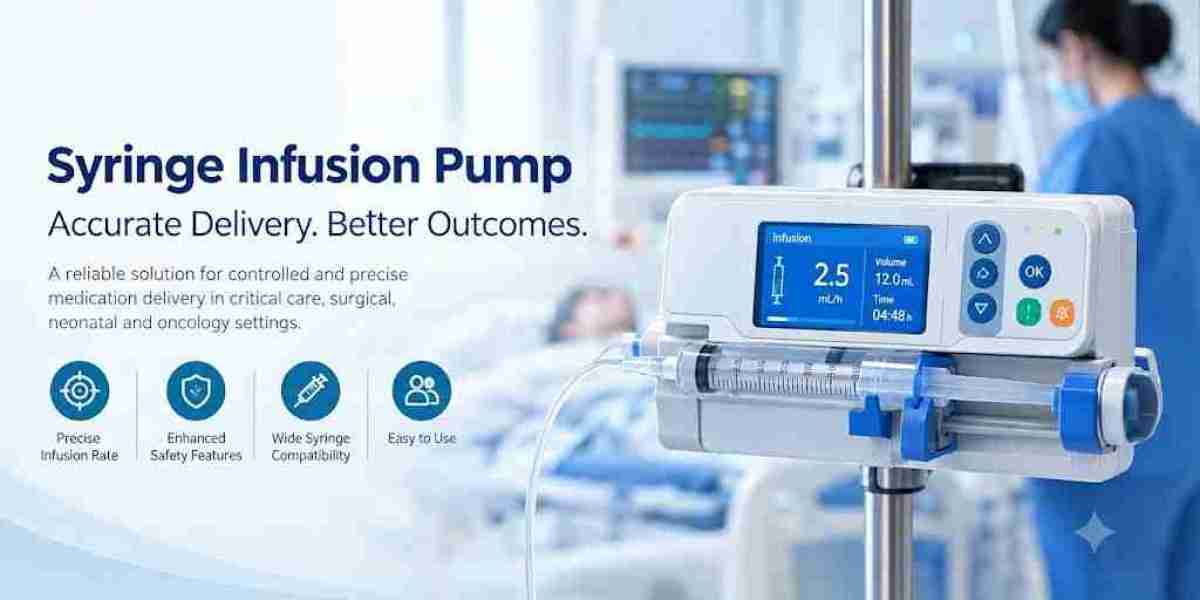

Accurate medication delivery is an important part of modern healthcare, particularly when patients require precise and continuous administration of medicines. In critical care, operating rooms, neonatal units, oncology departments, and other specialised healthcare settings, even small variations in medication delivery can affect patient care. A Syringe Infusion Pump is designed to provide controlled and consistent delivery of medications and fluids at a programmed rate.
Unlike manual injection methods, syringe-based infusion technology allows healthcare professionals to control the volume and speed of medication administration. This makes it a valuable medical device for situations where accurate dosing and steady infusion are required.
What Is a Syringe Infusion Pump?
A Syringe Infusion Pump is a medical device that delivers medication or fluids from a syringe into a patient's body at a controlled rate. The device uses a motor-driven mechanism to push the syringe plunger forward according to the settings programmed by the healthcare professional.
The infusion rate can generally be adjusted based on the patient's clinical requirements. Depending on the model and application, healthcare professionals can set parameters such as infusion rate, volume, and other relevant delivery settings.
A Syringe Pump is particularly useful when very small quantities of medication need to be delivered accurately over a specific period.
How Does a Syringe Pump Work?
A Syringe Pump works through a simple but controlled mechanism. A compatible syringe containing the required medication or fluid is securely positioned in the pump. The healthcare professional then programs the required infusion parameters.
Once started, the pump's drive mechanism moves the syringe plunger forward at the selected rate. This allows the medication or fluid to move through the connected administration line and reach the patient.
The controlled movement of the plunger helps maintain a consistent infusion rate throughout the programmed delivery period. Depending on the device, built-in alarms and monitoring functions can also help alert healthcare professionals to conditions that may require attention.
Key Applications of Syringe Infusion Pumps
Syringe infusion pumps are used across different hospital departments because of their ability to deliver small volumes with controlled flow. Common applications include:
Intensive Care Units
Patients in intensive care may require continuous administration of medicines at carefully controlled rates. A Syringe Pump can support the controlled delivery of medications according to prescribed requirements.
Neonatal and Paediatric Care
Newborns and children may require very small medication volumes. Precise infusion control can be especially important in these settings, where medication requirements can differ significantly from adult patients.
Operating Rooms
During surgical procedures, certain medications may need to be administered continuously and at controlled rates. Syringe infusion systems can support healthcare professionals in maintaining the prescribed delivery rate.
Oncology Care
Some treatments require controlled administration of medicines over a specified duration. Infusion pumps can help healthcare professionals manage the delivery process according to the prescribed protocol.
General Hospital Care
Depending on the clinical application, syringe-based infusion systems can also be used in emergency departments, wards, and other healthcare environments where controlled medication delivery is required.
Benefits of Using a Syringe Pump
A Syringe Pump offers several practical benefits for healthcare professionals when precise infusion is required.
Controlled medication delivery: The pump enables healthcare professionals to program a specific delivery rate based on the patient's treatment requirements.
Accurate low-volume infusion: Syringe-based systems are suitable for applications where relatively small quantities of medication or fluid need to be administered over time.
Continuous infusion: Instead of repeated manual administration, the device can support continuous delivery during the programmed infusion period.
Alarm and safety functions: Depending on the model, alarms can help identify conditions such as occlusion, low battery, syringe-related issues, or other operating conditions.
Flexible clinical use: Syringe infusion pumps can be used across several departments and clinical applications, making them a useful addition to hospital infusion equipment.
What to Consider When Choosing a Syringe Infusion Pump
Hospitals and healthcare facilities should consider several factors before selecting a Syringe Infusion Pump. The device should be appropriate for the intended clinical application and compatible with the syringes used by the facility.
Important considerations may include infusion accuracy, available flow-rate settings, syringe compatibility, user interface, alarm functions, battery performance, ease of operation, and maintenance requirements.
Healthcare facilities should also consider the availability of technical support, training, documentation, and after-sales service. Choosing equipment from an experienced medical device provider can help hospitals manage installation, operation, and ongoing maintenance more effectively.
Why Accurate Infusion Matters in Patient Care
Medication administration requires careful attention to dosage, timing, and delivery rate. Manual administration may not always provide the consistency required for certain clinical situations. A Syringe Infusion Pump can provide a controlled method of delivering medication and fluids, helping healthcare professionals follow prescribed infusion parameters.
The device does not replace clinical judgement. Instead, it acts as a controlled delivery system that supports healthcare professionals in managing medication administration according to the patient's treatment plan.
Choose the Right Syringe Pump for Your Healthcare Facility
Selecting the right Syringe Pump depends on the intended application, patient population, medication requirements, and operational needs of the healthcare facility. Hospitals should evaluate device specifications, safety features, ease of use, syringe compatibility, maintenance requirements, and service support before making a purchasing decision.
AKAS Infusions provides infusion solutions designed for healthcare environments where controlled and reliable medication delivery is important. Healthcare professionals and procurement teams can evaluate the available infusion equipment based on their specific clinical requirements.
For hospitals looking for a Syringe Infusion Pump, understanding the device's features, applications, and operational requirements is an important step toward selecting suitable infusion equipment.








