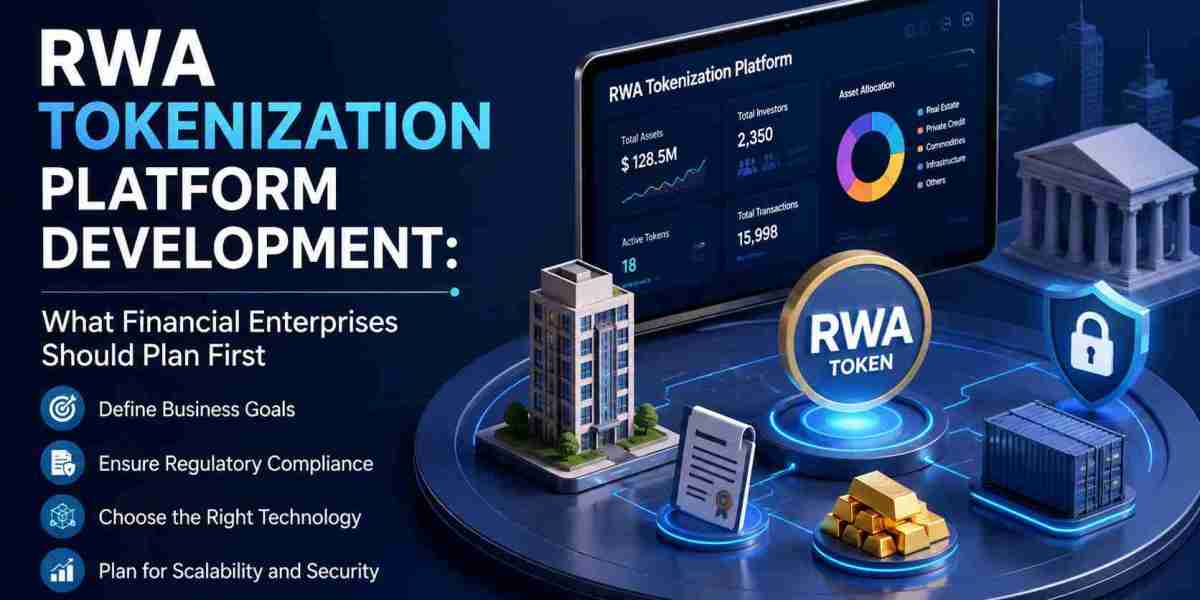

Financial institutions are increasingly looking at blockchain as a way to represent ownership of real-world assets in digital form. Real estate, private credit, commodities, funds, artwork, infrastructure, and other asset classes can be represented through blockchain-based tokens. This approach is commonly referred to as RWA Tokenization.
For financial enterprises, launching a tokenization platform involves much more than selecting a blockchain network and creating digital tokens. The project requires planning around asset selection, investor eligibility, legal structures, custody, token standards, compliance, payments, trading, reporting, and platform operations. Poor planning in any of these areas can create operational issues after launch.
A financial enterprise should therefore decide what it wants to tokenize, who will use the platform, which jurisdictions will be covered, how ownership will be represented, and how transactions will be controlled before development begins. This article explains the areas enterprises should plan first when starting an RWA tokenization platform development.
1. Decide Which Assets the Platform Will Support
The first decision concerns the type of real-world assets that will be represented on the platform. Different assets have different ownership structures, valuation methods, documentation requirements, investor profiles, and regulatory considerations.
A platform intended for commercial property may require property documentation, valuation records, rental information, ownership records, and distribution management. A private credit platform may need loan agreements, repayment schedules, borrower information, and credit assessments. Therefore, financial enterprises should avoid beginning with a broad asset category without first defining the exact assets.
Method
Start with one or two asset classes that match the enterprise's existing business activities. Document the asset value, ownership structure, income model, transfer rules, investor restrictions, and supporting documents. This gives the development team a practical foundation for designing token contracts and platform workflows.
2. Define the Business and Revenue Model
The platform should have a defined commercial model before development begins. Financial enterprises can generate revenue through issuance fees, transaction fees, asset management charges, subscription plans, custody services, listing fees, or secondary market activity.
The revenue structure also affects the platform's technical design. For example, a platform charging fees during token issuance will need an automated fee calculation and payment process. A marketplace charging transaction fees needs trading, settlement, and transaction history features.
Method
Prepare a revenue model showing each platform activity, the applicable fee, the party responsible for payment, and the settlement process. Estimate revenue based on expected asset volume, investor activity, and transaction frequency rather than relying only on token sales.
3. Select the Regulatory and Legal Structure
Regulatory planning should take place before technical development. Tokenized assets can fall under different financial regulations depending on the asset, investor type, jurisdiction, token rights, and distribution model.
A financial enterprise may need to determine whether it is issuing securities, fund interests, debt instruments, ownership interests, or another form of regulated asset. The legal structure may also determine investor onboarding procedures, reporting requirements, transfer restrictions, and custody arrangements.
Method
Work with legal and compliance teams to document the target jurisdictions, asset classification, investor categories, licensing requirements, KYC and AML procedures, and token transfer restrictions. These decisions should be converted into platform requirements before development starts.
4. Plan the Token Ownership Model
Tokenization is not simply about creating a digital representation of an asset. The token should have defined rights and responsibilities. Depending on the structure, a token may represent direct ownership, an interest in a legal entity, a claim on income, debt exposure, or participation in an investment vehicle.
The enterprise should decide how ownership is recorded and how token holders receive economic benefits. Distribution of rental income, interest, dividends, or other proceeds may also need to be reflected in the platform.
Method
Prepare a token specification covering ownership rights, income rights, voting rights, transfer conditions, redemption rules, token supply, issuance price, and investor restrictions. The specification can then guide the smart contract and platform development process.
5. Choose the Blockchain Network
Blockchain selection should be based on the project's operational requirements rather than popularity alone. Financial enterprises should assess transaction costs, network activity, smart contract capabilities, wallet support, interoperability, transaction finality, security history, and regulatory considerations.
Public and permissioned networks can both be considered depending on the business model. Some institutions may prefer controlled environments, while others may require access to broader blockchain ecosystems.
Method
Create a comparison covering several blockchain networks against transaction cost, contract support, settlement performance, wallet compatibility, ecosystem activity, and integration requirements. Select the network that fits the intended asset and investor workflow.
6. Plan the Compliance Architecture
Compliance should be part of the platform architecture rather than an activity performed only during investor registration. RWA platforms may require identity verification, investor accreditation checks, sanctions screening, transaction monitoring, jurisdiction restrictions, and ongoing compliance reviews.
The platform may also need to prevent restricted investors from purchasing certain tokens or transferring them to prohibited wallet addresses.
Method
Map every investor journey from registration to investment, transfer, redemption, and withdrawal. Mark the compliance checks required at each stage and connect those checks with the relevant platform functions. This approach helps reduce manual intervention and creates better audit records.
7. Design Investor Onboarding
Investor onboarding is one of the first areas users will interact with. A financial enterprise should decide whether the platform will serve retail investors, accredited investors, institutions, family offices, professional investors, or a combination of these groups.
The onboarding process may include identity verification, document submission, suitability checks, accreditation verification, wallet registration, payment setup, and agreement acceptance.
Method
Create separate onboarding paths for each investor category. Define the documents required, approval stages, verification checks, and account permissions. Connect the onboarding system with KYC and AML providers where appropriate.
8. Plan Custody and Wallet Management
Token ownership requires a practical approach to wallets and custody. Some investors may already use self-custody wallets, while others may prefer custodial accounts managed through financial institutions or regulated providers.
The platform should also consider lost credentials, wallet screening, transaction approvals, multi-signature controls, and recovery procedures. Institutional users may require additional approval layers before tokens can be transferred.
Method
Decide whether the platform will support custodial wallets, non-custodial wallets, or both. Establish wallet approval rules, transaction limits, recovery procedures, and administrative permissions before writing the token contracts.
9. Plan the Smart Contract Structure
Smart contracts manage important token functions such as issuance, transfer, burning, freezing, redemption, and distribution. The contract design should reflect the legal and business rules established earlier.
For regulated assets, unrestricted token transfers may not be suitable. The contract may need investor whitelisting, transfer restrictions, holding limits, compliance checks, and administrative controls.
Method
Prepare a smart contract specification before development. Include token issuance, supply management, transfer permissions, wallet restrictions, redemption, administrative roles, and emergency controls. Conduct independent testing and security reviews before deployment.
10. Design Asset Issuance and Verification
The platform needs a process for bringing assets into the tokenization system. This can involve asset documentation, valuation, ownership verification, legal review, token allocation, and issuance approval.
For Real World Asset Tokenization, asset verification is particularly important because the blockchain record alone does not prove the existence or value of an off-chain asset.
Method
Create an asset onboarding workflow covering document collection, ownership verification, valuation review, legal approval, asset registration, token issuance, and periodic updates. Maintain records connecting the digital token with its underlying legal and financial documentation.
11. Plan Payments and Settlement
Investors need a way to purchase tokens and receive proceeds. Depending on the platform, payments may involve fiat currencies, stablecoins, or other approved digital payment methods.
The enterprise should define how funds enter the platform, how purchases are settled, how fees are deducted, and how income distributions reach investors.
Method
Map the complete payment lifecycle from deposit to token purchase and final settlement. Include failed transactions, refunds, withdrawal procedures, payment reconciliation, and transaction reporting.
12. Consider Secondary Market Trading
A tokenization platform may eventually support secondary trading, allowing eligible investors to transfer or trade tokenized assets. However, secondary markets require additional planning around liquidity, investor eligibility, pricing, settlement, and compliance.
Not every tokenized asset will have immediate liquidity. Financial enterprises should therefore avoid assuming that tokenization automatically creates an active market.
Method
Decide whether trading will occur through an internal marketplace, an external exchange, peer-to-peer transfers, or another structure. Define who can trade, when trading is permitted, how prices are displayed, and which compliance checks apply to each transaction.
13. Plan Asset Valuation and Reporting
Investors need access to relevant information about the assets they hold. Depending on the asset type, this can include valuations, income statements, performance information, ownership records, distributions, and transaction history.
Financial enterprises should also consider reporting requirements for regulators, administrators, auditors, and internal teams.
Method
Define the reports required by investors, administrators, compliance teams, and management. Decide how frequently asset information should be updated and how historical records will be maintained.
14. Select the Right Development Partner
Choosing an experienced RWA Tokenization Company can influence the development process significantly. Financial enterprises should assess a provider's experience with smart contracts, financial applications, compliance workflows, wallet systems, asset management, security testing, and blockchain integration.
A provider offering RWA Tokenization Services should also understand that financial tokenization involves legal, operational, and technical requirements at the same time.
When comparing an RWA tokenization development company, enterprises should review previous projects, technical capabilities, security practices, development methodology, integration experience, maintenance plans, and post-launch support.
Method
Prepare a vendor evaluation checklist covering blockchain expertise, smart contract development, compliance integration, custody support, payment integration, platform security, testing, deployment, and ongoing maintenance. Compare providers against the same criteria before making a decision.
15. Decide Between Custom Development and a Ready-Made Solution
Financial enterprises can choose between developing a platform from the ground up or using an existing framework or white-label solution. Custom development can provide greater control over business workflows, while a ready-made platform may reduce initial development work.
The right choice depends on the enterprise's technical resources, budget, regulatory model, launch schedule, and product requirements.
Method
List the functions that must be unique to the business and those that can use established modules. Compare development time, maintenance responsibilities, integration requirements, licensing costs, and future modification needs before selecting an approach.
16. Plan Security and Testing
Tokenization platforms handle valuable assets and sensitive investor information, making security planning necessary from the beginning. Smart contracts, APIs, wallets, authentication systems, databases, payment modules, and administrative dashboards all require testing.
A single weakness can affect token ownership records, investor information, or financial transactions.
Method
Use multiple testing stages covering smart contracts, APIs, authentication, wallet operations, payment processing, role permissions, and database security. Conduct independent smart contract audits and penetration testing before production deployment.
17. Prepare for Platform Operations After Launch
Development does not end when the platform goes live. Asset information may need updates, investor accounts may require support, compliance checks may change, and smart contracts may need administrative management.
Financial enterprises should have a defined operating model covering support, compliance reviews, asset administration, technical monitoring, reporting, and incident handling.
Method
Create an operational plan that assigns responsibilities to technology, compliance, finance, legal, asset management, and customer support teams. Establish procedures for system incidents, investor requests, asset updates, and regulatory changes.
Conclusion
RWA Tokenization can provide financial enterprises with a digital framework for representing and managing interests in real-world assets, but the project should begin with business, legal, compliance, and operational planning rather than software development alone. Enterprises should first decide which assets they will support, how ownership will work, which investors they will serve, how compliance will be handled, which blockchain network fits their requirements, and how custody, payments, reporting, and trading will operate. Working with an experienced provider can also reduce gaps between financial requirements and technical implementation. Enterprises evaluating Real World Asset Tokenization Services should assess providers based on blockchain knowledge, smart contract experience, compliance integration, security testing, and platform support. Blockchain App Factory provides RWA tokenization development services for businesses planning platforms for tokenized real-world assets, covering development requirements across token creation, platform functions, smart contracts, wallets, and related blockchain integrations.
FAQs
1. What is RWA Tokenization Platform Development?
RWA Tokenization Platform Development refers to creating a blockchain-based platform that represents ownership or financial interests in real-world assets through digital tokens. The platform can support asset issuance, investor onboarding, compliance, custody, transactions, reporting, and token management.
2. Which assets can be tokenized through an RWA platform?
Common examples include real estate, private credit, commodities, investment funds, infrastructure, artwork, intellectual property, and other assets with identifiable ownership or financial rights.
3. Why should financial enterprises plan compliance before development?
Compliance requirements can affect investor onboarding, token transfers, wallet permissions, reporting, and transaction monitoring. Defining these requirements early helps developers incorporate the required controls into the platform architecture.
4. What does an RWA Tokenization Company provide?
An RWA Tokenization Company may provide services covering platform architecture, smart contract development, token creation, wallet integration, investor management, payment integration, compliance modules, testing, deployment, and maintenance.
5. What are RWA tokenization development services?
RWA tokenization development services generally cover the technical work required to create a platform for issuing and managing tokenized real-world assets. Services can include smart contracts, dashboards, APIs, wallets, asset management modules, investor onboarding, and blockchain integration.
6. What is the role of smart contracts in RWA tokenization?
Smart contracts can manage token issuance, transfers, supply, investor restrictions, redemption, and other predefined rules. Their functions should correspond with the legal structure and business rules of the tokenized asset.
7. What is RWA token development?
RWA token development involves creating digital tokens that represent ownership, financial rights, or another defined interest associated with a real-world asset. The token design depends on the asset structure and applicable regulations.
8. How should enterprises select an RWA tokenization development company?
Enterprises should assess blockchain experience, smart contract capabilities, security practices, compliance integrations, financial application experience, previous projects, testing procedures, and post-launch support before selecting a development company.
9. Can an RWA platform support secondary trading?
Yes, an RWA platform can include secondary trading or transfer functionality when the asset structure and applicable regulations permit it. Investor eligibility, transfer restrictions, liquidity, settlement, and compliance requirements should be considered before adding such functionality.
10. What should enterprises plan first for rwa tokenization platform development?
Enterprises should first define the asset class, legal structure, investor groups, jurisdictions, ownership model, compliance requirements, revenue model, custody approach, blockchain network, and platform workflows. These decisions provide the foundation for subsequent technical development.








